
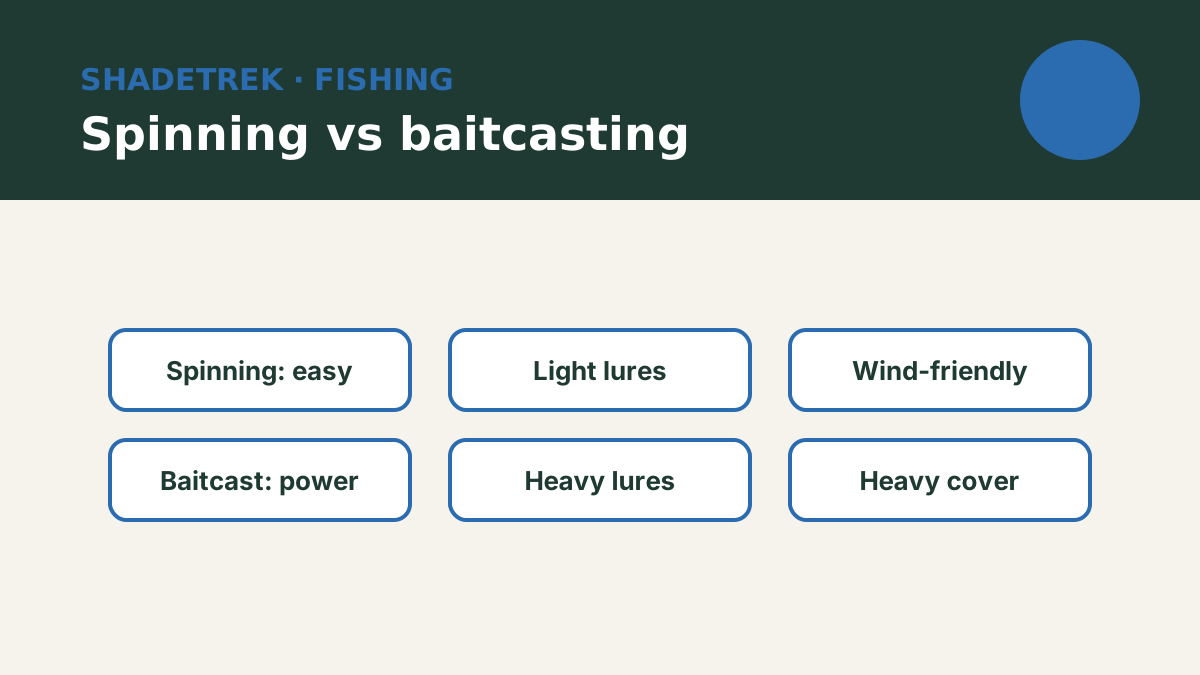
Walk into any tackle shop and you'll see two main kinds of reels: spinning reels that hang under the rod, and baitcasting reels that sit on top. Both cast lures and fight fish, but they work very differently, and each has situations where it shines. This guide explains the differences and helps you decide which to start with, drawing on guidance from Take Me Fishing and Bassmaster.
How each reel works
Spinning reels
A spinning reel has a fixed spool that doesn't turn during the cast. You open the bail (a wire arm), hold the line with a finger, cast, and the line spirals off the front of the spool. Bassmaster notes that the reel sits beneath the rod and that the line flows smoothly off the spool, which is why spinning reels are forgiving and rarely tangle. Spinning rods have large guides near the reel that get smaller toward the tip, to control those coils of line.
Baitcasting reels
On a baitcaster, the spool itself spins as line goes out. You press a thumb bar to free the spool, cast, and control the spool with your thumb and the reel's brake settings. If the spool spins faster than the line can leave, line piles up on itself into a tangle called a backlash or "bird's nest." Take Me Fishing notes that casting rods often have a trigger under the reel seat and smaller guides, with the reel mounted on top.
Side-by-side
| Spinning | Baitcasting | |
|---|---|---|
| Learning curve | Easy | Steeper; backlashes while learning |
| Light lures | Excellent | Harder; most need heavier lures to cast well |
| Heavy lures | Workable | Excellent |
| Line | Best with lighter line | Handles heavier line well |
| Accuracy | Good | Very good, with thumb control |
| Wind | More forgiving | Wind increases backlash risk |
| Power in cover | Moderate | High |
| Hand position | Reel under the rod | Reel on top |
When spinning is the better choice
- You're new to fishing. Take Me Fishing recommends that new anglers start with a spinning rod to build their skills.
- Light lures and finesse rigs. Bassmaster says spinning reels are ideal for lighter lines and smaller lures, like soft plastics and finesse presentations, and for clear water where stealth matters.
- Wind. Take Me Fishing notes spinning gear handles windy conditions better because there's no backlash to worry about.
- Live bait and small species. Trout, panfish and live-bait rigs are natural fits.
- Skipping baits under docks. Take Me Fishing calls spinning gear more forgiving for skipping under docks and overhanging trees.
When baitcasting is the better choice
- Heavier lures. Bassmaster highlights jigs, spinnerbaits and crankbaits as baitcaster territory.
- Heavier line. Take Me Fishing suggests a baitcaster as a rule of thumb when you're fishing line of 10 lb test or heavier.
- Thick cover. More power to pull fish out of weeds, timber and docks.
- Accuracy and repetition. With practice, thumb control lets you stop a lure right where you want it, cast after cast.
- Fast retrieves. Take Me Fishing notes that higher gear ratios on many baitcasters pick up line quickly with spinnerbaits, crankbaits and buzzbaits.
Learning to cast a baitcaster
If you're ready to try, Take Me Fishing's step-by-step guide suggests:
- Pair the reel with a medium-heavy casting rod, around 6'6" to 6'10".
- Learn with heavier monofilament, around 15 to 17 lb, which is easier to manage.
- Set the spool tension and brakes using the reel's manual. A common check is that the lure falls slowly and smoothly when you press the thumb bar.
- Keep your thumb lightly on the spool through the cast, pressing firmly at the start and feathering off, then stopping the spool as the lure lands.
Practice in a yard or park with a casting plug before you hit the water. Start with short, controlled casts, then loosen the brakes gradually as your thumb gets better.
Common beginner mistakes
- Buying a baitcaster first because the pros use one. You'll spend more time picking out tangles than fishing.
- Putting very light line on a baitcaster. Light line and light lures are where baitcasters struggle most.
- Overfilling a spinning reel. Fill the spool to just below the lip. Too much line jumps off in loops and tangles.
- Ignoring the drag. On either reel, set the drag so a hard pull takes line before the line breaks. Bassmaster suggests keeping a spinning reel's drag on the lighter side when targeting bigger bass.
- Cranking against the drag. If line is slipping, let the rod do the work and reel as you lower the rod tip.
Match the rod to the reel
Spinning reels go on spinning rods, and baitcasters go on casting rods. Take Me Fishing says it plainly: pair a spinning reel with a spinning rod and a baitcasting reel with a casting rod. The guide sizes and reel seats are designed for each type, and mixing them causes casting problems.
Should you own both?
Many bass anglers do: a spinning rod for finesse plastics and light lures, and a baitcaster for jigs, spinnerbaits and heavy cover. If you're starting out, buy a good spinning setup first. Our bass fishing for beginners guide walks through it.
Where to start
ShadeTrek doesn't test fishing gear hands-on. Our top spinning rod picks start with the Ugly Stik GX2. If you're ready for a baitcaster, our fishing page also lists casting gear such as the Abu Garcia Vendetta casting rod and Max Toro low-profile reel. For reel features, see our spinning reel guide.
Key takeaways
- Spinning reels are easier to learn and better with light lures, light line and wind.
- Baitcasters shine with heavier lures, 10 lb+ line and thick cover, but take practice to avoid backlash.
- Take Me Fishing recommends new anglers start with a spinning rod.
- Always pair spinning reels with spinning rods and baitcasters with casting rods.
- Many bass anglers carry both: spinning for finesse, baitcasting for power.
FAQ
Is spinning or baitcasting better for beginners?
Spinning. It's easier to cast and rarely tangles. Take Me Fishing recommends new anglers start with a spinning rod.
What is a backlash on a baitcaster?
A tangle that happens when the spool spins faster than line leaves it, so line piles up on the reel. Proper brake and spool tension settings and thumb control prevent it.
When should I use a baitcaster?
For heavier lures, line around 10 lb test or heavier, thick cover, and when you want maximum accuracy and power.
Can I put a baitcaster on a spinning rod?
No. Spinning and casting rods have different guides and reel seats. Match each reel to its own rod type.
Why do pros use baitcasters?
Baitcasters give more control and power with heavy lures and in cover, but pros also use spinning gear for finesse and light lures.
Sources
- Take Me Fishing: Casting vs Spinning Rod
- Take Me Fishing: How to Cast a Baitcaster
- Bassmaster: Understanding spinning and baitcasting reels
This article is research-based. ShadeTrek did not test these products; information comes from the linked standards, expert guides, manufacturer specs and owner reviews. Some links are affiliate links. Not medical or safety advice for your specific situation.