
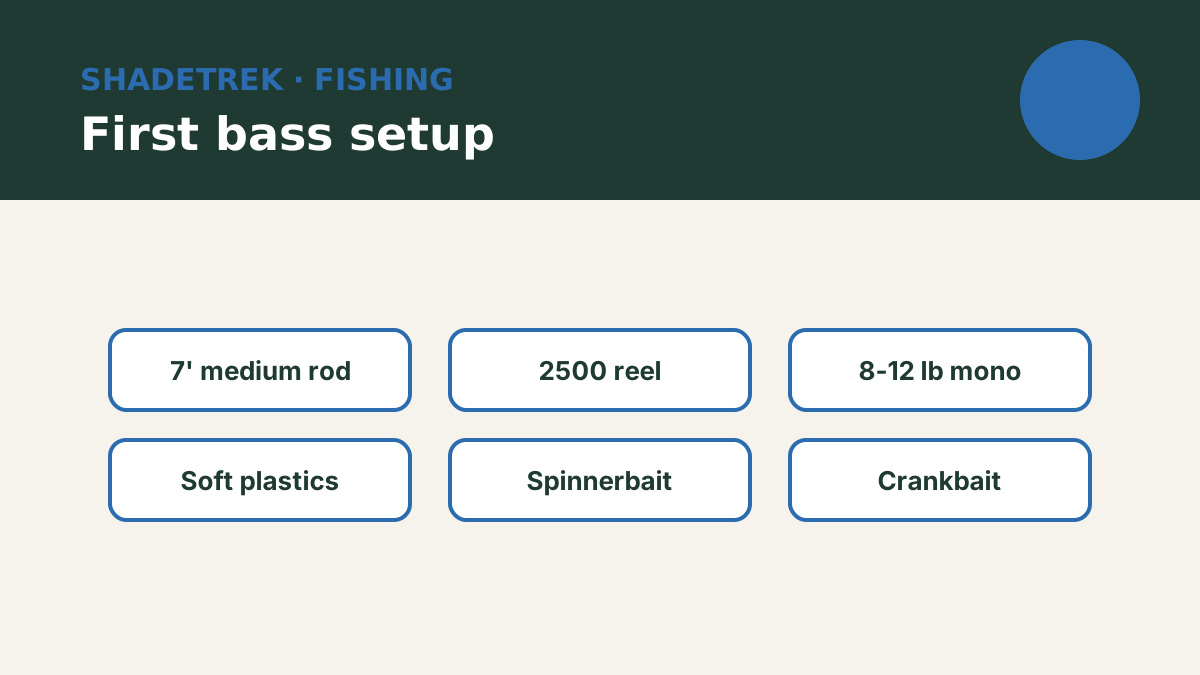
Bass are the most popular freshwater game fish in the US for good reason. They live in ponds, lakes and rivers across the country, they hit lures aggressively, and they fight hard. The gear aisle can be overwhelming, though, with specialized rods for every technique. You don't need any of that to start. This guide covers one versatile setup that handles most beginner bass fishing, based on advice from Take Me Fishing and Bassmaster's beginner workshop.
The rod: 6'6" to 7', medium power
Take Me Fishing's beginner tips say a medium-action spinning combo in the 6.5- to 7-foot range works fine for new bass anglers, and that you don't need a baitcaster to catch bass. That length casts far enough for most banks and boats while staying easy to control.
- Power (how much force bends the rod): medium handles the lure weights and fish sizes you'll meet most often. Medium-heavy is better for heavy cover and bigger lures, and medium-light for small finesse baits.
- Action (where the rod bends): fast or moderate-fast rods bend mostly in the upper third, giving good hook sets with single-hook soft plastics while still casting smoothly.
- Material: graphite is lighter and more sensitive, so you feel bites more clearly. Fiberglass and composite rods are tougher and more forgiving.
Our spinning rod guide explains length, power and action in more depth.
The reel: a 2500 to 3000 spinning reel
Bassmaster describes spinning reels as a great starting point because they're easy to use, forgiving when casting, and less prone to tangles and backlashes than baitcasters. For bass, a 2500 or 3000 size (on the common Shimano and Daiwa scale) balances line capacity and weight on a 7-foot medium rod. Look for:
- Smooth drag that releases line steadily without jerking.
- A gear ratio around 5:1 to 6:1 for an all-purpose retrieve speed.
- A reel that matches the rod. Combos take the guesswork out, and many beginners start with one.
Our spinning reel buying guide explains sizes, gear ratios and drag.
The line: mono, fluorocarbon or braid
| Line | Pros | Cons | Best for |
|---|---|---|---|
| Monofilament | Cheap, easy to tie, stretchy and forgiving, manages well on spinning reels | Stretch reduces sensitivity, and it weakens with sun exposure | First setups, topwater, crankbaits |
| Fluorocarbon | Low visibility underwater, abrasion resistant, sinks | Stiffer and springier on spinning reels, costs more | Clear water, leaders, soft plastics |
| Braid | Very strong for its diameter, almost no stretch, very sensitive | Visible in clear water, needs special knots, can dig into itself | Heavy cover, main line with a fluorocarbon leader |
For a first spinning setup, 8 to 12 lb monofilament is the simplest choice. It's forgiving if you set the hook too hard or the drag is a little tight. As you gain experience, many anglers switch to braid as the main line with a few feet of fluorocarbon leader, which combines strength and sensitivity with low visibility. Take Me Fishing's baitcaster guide suggests heavier line, 10 lb and up, is where baitcasters start to make more sense.
Five lures to start with
Take Me Fishing recommends choosing lures that imitate what bass are eating where you fish, such as shad, shiners, crayfish and frogs. These five cover most situations:
- Soft plastic worm rigged Texas style or wacky style. It's the most versatile bass bait, and it works slowly along the bottom when bass are less active.
- Spinnerbait. Its flashing blades and vibration help fish find it in stained water. Cast and retrieve steadily.
- Crankbait. Imitates baitfish and dives to a set depth. Take Me Fishing suggests rattling crankbaits in cloudy or muddy water.
- Soft plastic creature or crayfish bait on a jig or Texas rig, for working around rocks and cover.
- Topwater lure such as a popper or walking bait, for early mornings, evenings and calm days.
Add a pack of offset worm hooks, a few bullet weights and a small tackle box.
Other essentials
- Fishing license: required for most anglers in most states. Check your state's rules and limits before you go.
- Pliers or a hook remover to unhook fish quickly.
- Line clippers.
- Polarized sunglasses to cut glare and spot cover, fish and underwater structure. See our fishing sunglasses guide.
- Sun protection: a hat and sunscreen.
Where to find bass
Take Me Fishing's bass tips emphasize cover: docks, fallen trees, weed edges, rocks and lily pads, where bass ambush prey. Early morning and evening are often productive, especially in summer. If you see bass chasing bait near the surface, try faster, larger lures. If not, slow down with a soft plastic near the bottom.
When to add a baitcaster
Bassmaster describes baitcasters as offering more control and power with heavier lures and in thick cover, but they take practice to cast without backlashes. Many anglers add one as a second rod once they're comfortable. Our spinning vs baitcasting guide explains the trade-offs.
Where to start
ShadeTrek doesn't test fishing gear hands-on. Our top spinning rod picks compare specs and owner reviews. The Ugly Stik GX2 is our durable all-rounder for beginners, the Ugly Stik Carbon is a lighter, more sensitive step up, and the Fenwick Eagle Bass is built specifically for bass.
Key takeaways
- A 6'6" to 7' medium spinning rod is a versatile first bass setup, which Take Me Fishing recommends for beginners.
- Pair it with a 2500 to 3000-size spinning reel with smooth drag.
- 8 to 12 lb monofilament is the simplest first line. Braid with a fluorocarbon leader is a common upgrade.
- Five lures cover most situations: soft plastic worm, spinnerbait, crankbait, creature bait and topwater.
- Fish near cover and get a license. Add a baitcaster once you're comfortable.
FAQ
What size rod is best for beginner bass fishing?
A 6'6" to 7' medium-power spinning rod. Take Me Fishing says a medium 6.5- to 7-foot spinning combo works fine for beginners.
What line should I use for bass?
8 to 12 lb monofilament is easiest for beginners on a spinning reel. Fluorocarbon is less visible, and braid is strongest and most sensitive.
Do I need a baitcaster for bass?
No. Spinning reels catch plenty of bass and are easier to learn. Baitcasters help with heavier lures and line and thick cover.
What is the best lure for beginner bass fishing?
A soft plastic worm is the most versatile. Spinnerbaits, crankbaits and topwater lures round out a starter kit.
What size spinning reel for bass?
A 2500 or 3000 size suits most bass fishing on a 6'6" to 7' medium rod.
Sources
- Take Me Fishing: Bass Fishing for Beginners
- Take Me Fishing: Bass Fishing Tips
- Take Me Fishing: How to Cast a Baitcaster
- Bassmaster: Understanding spinning and baitcasting reels
This article is research-based. ShadeTrek did not test these products; information comes from the linked standards, expert guides, manufacturer specs and owner reviews. Some links are affiliate links. Not medical or safety advice for your specific situation.