
Almost every pair of sunglasses has a sticker promising UV protection, and many say "UV400." It's one of the most useful labels on a pair of sunglasses, and one of the most misunderstood. This guide explains what the number means, why it matters for your eyes, and what the label doesn't tell you.
A quick primer on UV light
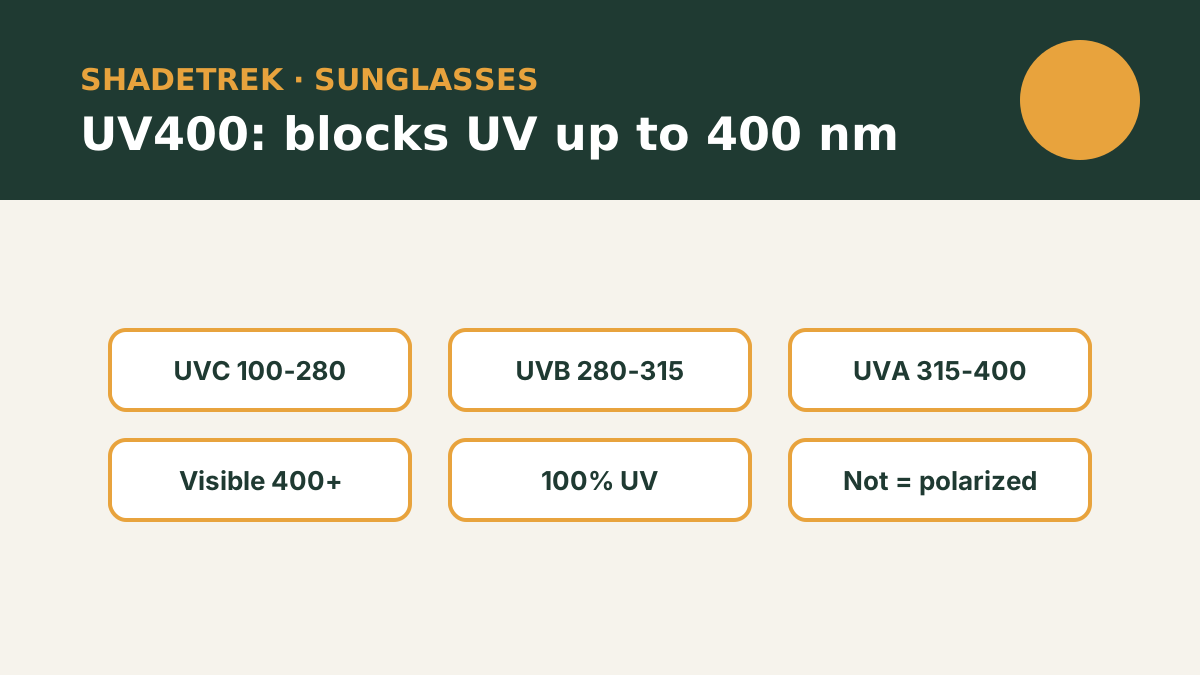
Ultraviolet (UV) radiation is invisible light with shorter wavelengths than visible light. The World Health Organization divides it into three bands:
- UVC (100–280 nm): absorbed by the atmosphere's ozone layer, so it doesn't reach the ground in meaningful amounts.
- UVB (280–315 nm): partly absorbed by the atmosphere. It causes sunburn and is linked to skin and eye damage.
- UVA (315–400 nm): most of the UV that reaches the ground. It penetrates more deeply.
Visible light starts at roughly 400 nm. So a lens that blocks everything up to 400 nm blocks the whole UV band that reaches you.
What "UV400" actually promises
UV400 is a statement that the lens blocks UV wavelengths up to 400 nanometers. In practice it means the same thing as "100% UV protection" or "blocks 100% of UVA and UVB." The American Academy of Ophthalmology recommends sunglasses that block 100% of UV rays. It also notes that drugstore sunglasses labeled 100% UV-blocking are a better choice than designer sunglasses with no protection.
Some older labels say "blocks 99% of UV" or "meets ANSI Z80.3 UV requirements." The ANSI Z80.3 standard is the US voluntary standard for non-prescription sunglasses, and it includes UV transmittance limits along with optical and impact requirements. Labels that specifically say UV400 or 100% UV are the clearest.
Why it matters for your eyes
The AAO's sun and eye health guidance links UV exposure to eye problems including cataracts, growths on the eye and cancers of the eyelid and surrounding skin. The WHO also identifies cataracts as a major eye condition associated with UV exposure. Short, intense exposure can cause photokeratitis, essentially a sunburn of the cornea, which is a known risk around snow and water.
UV exposure varies a lot. The EPA's UV Index rates daily UV risk from low to extreme and notes that UV is strongest around midday, at higher altitudes and near reflective surfaces like snow, sand and water. Clouds don't block all of it. Those are exactly the places outdoor sunglasses get used.
What UV400 does NOT tell you
It's not about darkness
Lens darkness controls how much visible light gets through. UV protection comes from the lens material or a coating, and it's invisible. A very light lens can block 100% of UV, and a dark lens can block very little. The AAO is blunt about it: don't assume a darker lens protects more. Only 100% UV protection does. A dark lens without UV blocking can also make your pupils open wider, which is why eye-care groups warn against cheap tinted lenses with no UV rating.
It's not polarization
Polarization cuts reflected glare from water, roads and snow. It improves comfort and visibility, but it is a separate feature from UV protection. The AAO notes that polarization alone doesn't block UV. Most quality polarized lenses are also UV400, but check the label. For more, read our polarized vs non-polarized guide.
It's not optical quality or impact resistance
UV400 says nothing about distortion, clarity or how well the lens resists impact. Those come down to the lens material (polycarbonate, nylon, glass), manufacturing and standards testing. Sport and safety eyewear may carry separate impact ratings.
It's not about blue light
400 nm is the boundary of UV. Some brands also advertise blue-light filtering, which is a different, visible part of the spectrum.
Does price matter?
For UV protection itself, not much. UV-blocking materials and coatings are inexpensive, and the AAO says sunglasses don't have to be expensive to be safe and effective. Many of the pairs in our under-$50 guide are labeled UV400 and polarized. Higher prices usually buy better optics, lighter frames, scratch-resistant coatings, glass lenses, warranties and fit options.
How to check your sunglasses
- Read the label or listing for "UV400," "100% UV protection" or "blocks 100% of UVA and UVB."
- Buy from a reputable seller. Counterfeit and no-name products sometimes make claims they don't meet.
- Ask an optician. The AAO notes you can take sunglasses to a local optical shop to test their UV protection.
- Be wary of phone or flashlight tricks from social media. A small UV flashlight can show fluorescence on a banknote behind the lens, but it isn't a calibrated measurement.
Beyond the lens
Even UV400 lenses let some light reach your eyes from the sides and top. Larger frames or wraparound styles, plus a wide-brimmed hat, give more complete coverage. On snow, water or at altitude, side coverage matters even more, which is why mountaineering glasses often add side shields. Our hiking sunglasses guide includes glacier-style options.
Where to start
ShadeTrek doesn't run lab tests. Every pair in our sunglasses guides is listed by the brand or retailer as offering full UV protection, and we note polarization separately. Start with the best sunglasses overall, or if you mainly need glare control on water, the fishing guide. Not sure about style? See how to choose sunglasses for your face shape.
Key takeaways
- UV400 means a lens blocks UV light up to 400 nm, covering both UVA and UVB. It is equivalent to 100% UV protection.
- The AAO recommends sunglasses that block 100% of UV rays.
- Darkness and UV protection are separate. Only a 100% UV or UV400 label means real UV protection.
- Polarization reduces glare but isn't the same as UV protection.
- You don't need to pay a lot for UV400. Price mostly buys optics, comfort and durability.
FAQ
What does UV400 mean on sunglasses?
It means the lenses block ultraviolet light with wavelengths up to 400 nanometers, which covers UVA and UVB. It's equivalent to 100% UV protection.
Is UV400 the same as polarized?
No. UV400 refers to UV blocking. Polarization reduces reflected glare. A lens can be one, both or neither, so check for both labels.
Are darker sunglasses better for UV?
No. Darkness affects visible light only. UV protection comes from the lens material or coating, which you can't see.
Do cheap UV400 sunglasses work?
A lens that genuinely meets UV400 blocks UV regardless of price. Buy from reputable sellers, since some no-name products make claims they don't meet.
Do I need UV protection on cloudy days?
Yes. The EPA notes that UV can pass through clouds, and it's stronger at altitude and near snow, sand and water.
Sources
- American Academy of Ophthalmology: Recommended Types of Sunglasses
- American Academy of Ophthalmology: Sun and eye health
- World Health Organization: Radiation, ultraviolet (UV)
- US EPA: UV Index Scale
This article is research-based. ShadeTrek did not test these products; information comes from the linked standards, expert guides, manufacturer specs and owner reviews. Some links are affiliate links. Not medical or safety advice for your specific situation.