
Lumens are the headline spec on every headlamp, which makes it tempting to buy the brightest one you can afford. But a headlamp's maximum mode usually lasts only a couple of hours, and how far the light reaches depends heavily on the shape of the beam. Here's how to pick a sensible brightness for hiking without overpaying or running out of light.
Who this guide is for
This guide is for day hikers who want a headlamp for early starts, sunsets that come sooner than planned, or the walk back to the car, and for new campers buying their first light. A headlamp is one of the Ten Essentials on our day hike packing checklist, so it belongs in your pack even on hikes you expect to finish in daylight. Trail runners and mountaineers need more light than this guide focuses on.
What matters most
1. Lumens by activity
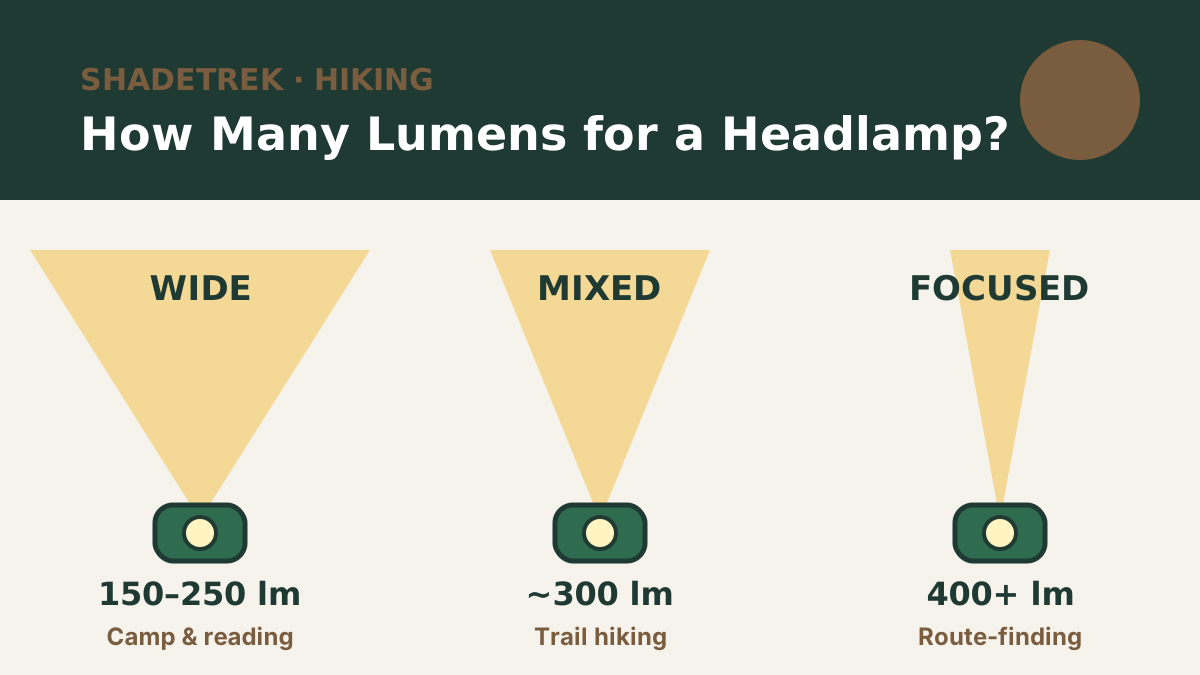
Brands and outdoor retailers give similar ranges. These are guidelines, not hard rules:
| What you're doing | Lumens that usually work | Source |
|---|---|---|
| Reading, cooking, camp chores, walking in the dark | 150–250 lumens is enough | Black Diamond |
| Close-up work, setting up camp, reading in the tent | 25+ lumens (low mode) | MEC |
| Night hiking or running in the dark | 200+ lumens | MEC |
| Route-finding and challenging terrain | 400+ lumens | Black Diamond |
| Night mountain biking or skiing | 600+ lumens | MEC |
The practical takeaway: a lamp with a roughly 300-lumen maximum and a usable 100-lumen middle mode covers most trail hiking, with a bright burst in reserve for a tricky junction.
2. Beam type: wide, mixed or focused
Petzl's beam guide sorts headlamps into three beam patterns. A wide beam gives even, close-range light for camp, reading and slow movement. A mixed beam (wide plus focused) adds depth and is the one Petzl matches to hiking and trekking. A focused beam throws light far for trail running, biking and navigation. Petzl also warns that a flood beam isn't suited to distance vision in the mountains, while a focused beam is poor for reading a map.
Beam shape changes reach a lot. In Petzl's example, the same 100 lumens projects about 40 meters in a very wide beam and up to 100 meters in a narrow one.
3. How to read beam distance and runtime
Most major brands publish numbers under the ANSI/PLATO FL 1 standard, which makes lamps comparable, as long as you know what the numbers mean:
- Beam distance is how far the light reaches before it fades to 0.25 lux, roughly the light of a full moon, according to REI's flashlight guide. It's the outer edge of useful light.
- Runtime is measured until output falls to 10% of its starting level. REI's headlamp brightness explainer gives the example of a 300-lumen light being timed until it dims to 30 lumens.
- Lumens on the box are the brightest mode at switch-on, not an average over the whole battery.
So compare lamps at the middle setting you'll actually use, not just the maximum.
4. Power: AAA batteries or rechargeable
Black Diamond notes that rechargeable headlamps generally offer higher output, while lamps that also take AAA batteries are handy on long trips and are often more affordable. Some lamps, including the two Petzl models below, run on either a rechargeable pack or three AAA batteries. Whichever you choose, start the hike with a full charge or fresh batteries.
5. Red light, tilt and weather resistance
A red mode preserves your night vision and is kinder to the people around you. A tilting lamp body lets you aim light at your feet. An IPX4 rating means the lamp is made to handle rain and splashes, which is enough for most hiking; it isn't rated for being dunked.
Mistakes to avoid
- Buying on the maximum lumen number alone. Check the beam type and the middle-mode runtime.
- Hiking on max mode. It drains the battery fastest. Use it in short bursts.
- Trusting beam distance as reading distance. At the rated distance you're down to moonlight.
- Leaving the headlamp home on "short" hikes. Delays and early sunsets in fall catch people out.
- Packing it loose with the switch unlocked. Use the lock function if your lamp has one so it doesn't drain in your pack.
- Not carrying backup power. Spare AAAs or a charged battery weigh very little.
Two headlamps that fit the ranges above
Petzl TIKKINA (300 lumens, wide beam)
A simple, budget-friendly lamp for camp and easy trail walking. Petzl lists 300 lumens, 92 g, a wide beam, IPX4 weather resistance and three included AAA batteries, with the optional CORE rechargeable battery as an accessory. On AAA batteries its STANDARD mode is 100 lumens with a 40 m beam for 10 hours (plus 20 hours of reserve lighting), and MAX POWER is 300 lumens at 65 m for 2.5 hours. Because the beam is wide, it's best for camp and maintained trails rather than spotting things far ahead. Check price on Amazon #ad
Petzl ACTIK CORE (625 lumens, wide or mixed beam)
A rechargeable lamp with a mixed beam for moving on the trail. Petzl lists 625 lumens, 88 g, wide or mixed beam, IPX4, red lighting and the included CORE rechargeable battery (1250 mAh, USB-C, 3.5 h charge), and it also runs on three AAA batteries. With the CORE battery its STANDARD mode is 100 lumens at 60 m for 7 hours (plus 2 hours reserve), and MAX POWER is 625 lumens at 115 m for 2 hours. It suits hikers who start before dawn, hike after dark or want extra reach for route-finding. Check price on Amazon #ad
A headlamp is small, so pack it where you can reach it: see our daypack guide for pocket layouts that help. Fall evenings get cold fast, so pair it with the layers in our fall hiking layering guide, and check current packs and boots on our hiking gear deals page.
Key takeaways
- About 300 lumens max covers most trail hiking; 150–250 lumens is enough for camp and walking in the dark.
- Go 400+ lumens with a mixed or focused beam for route-finding or fast night travel.
- Beam shape decides reach as much as lumens do.
- Compare runtime at the middle mode, since FL 1 runtime counts down to 10% output.
- Carry backup batteries or a charged battery, and lock the lamp in your pack.
FAQ
How many lumens do I need for hiking at night?
For walking a maintained trail, a lamp that tops out around 300 lumens gives you headroom, and you'll spend most of the hike on a 100 to 200 lumen middle setting. MEC lists 200+ lumens as good for night hiking, and Black Diamond recommends 400+ for route-finding on challenging terrain.
Is 300 lumens enough for a headlamp?
For most hikers, yes. Black Diamond says 150 to 250 lumens is enough for reading or walking in the dark, so a 300 lumen maximum covers camp and trail walking. Step up to 400+ lumens with a mixed or focused beam if you move fast at night or need to spot trail markers far ahead.
Are more lumens always better?
No. Brighter modes drain the battery faster, and Petzl notes that beam shape decides how far the light reaches: 100 lumens projects about 40 meters in a very wide beam but up to 100 meters in a narrow one. A very bright lamp in a group can also be annoying, MEC points out.
What does beam distance mean on a headlamp box?
Under the ANSI/PLATO FL 1 standard it is the distance where the light falls to 0.25 lux, roughly the light of a full moon. Treat it as the outer edge of useful light, not the distance you can comfortably read a trail sign.
Why does my headlamp die sooner than the box says?
FL 1 runtime is counted until output drops to 10% of where it started, so a 300 lumen mode is still 'running' at 30 lumens. Compare runtime at the middle setting you'll actually use, and carry spare batteries or a charged battery on long outings.
Sources
- Black Diamond: How to Choose the Best Headlamp
- MEC: How to Choose a Headlamp
- Petzl: Beam pattern
- Petzl: Brightness or burn time
- REI Expert Advice: How to Choose a Flashlight (FL 1 definitions)
- REI Uncommon Path: Understanding Headlamp Brightness
- Petzl TIKKINA specifications
- Petzl ACTIK CORE specifications
This article is research-based. ShadeTrek did not test these products; information comes from the linked expert guides and manufacturer specs. Some links are affiliate links. Not safety advice for your specific situation.