
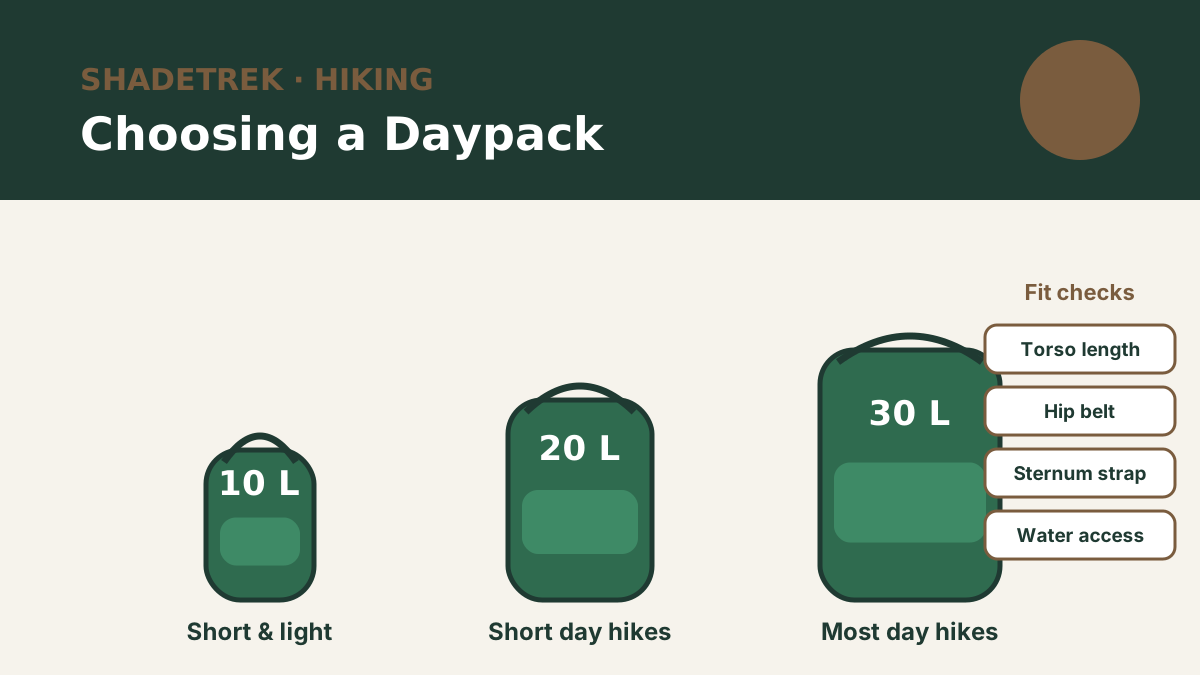
A daypack is the one piece of gear you wear for the whole hike, so a bad fit or the wrong size shows up fast as sore shoulders, a bouncing load or a jacket you can't fit in. The good news is that choosing one comes down to three questions: how much you carry, how the pack fits your body, and which features you'll actually use.
Who this guide is for
This guide is for new and casual hikers buying their first real hiking pack, and for anyone deciding whether the backpack they already own is good enough for the trail. It covers hikes of a few hours up to a full day. If you're planning overnights, you'll want a larger framed backpacking pack instead.
What matters most
1. Capacity: size by your fullest realistic load
REI's daypack guide says daypacks range from about 5 to 40 liters and recommends working backward from the most gear you might carry. Its size bands are a useful starting point:
| Size | Good for |
|---|---|
| 10 L or smaller | Running, road biking and short hikes with only a few essentials |
| 11–20 L | Compact hiking, biking and travel packs with room for an extra layer, food and day-trip gear |
| 21–35 L | REI's "sweet spot" for most hiking daypacks: food, clothing and small extras like a camera |
| 36–40 L | Climbing, cold-weather hiking, parents carrying kids' gear, or ultralight overnights |
REI also warns that bigger isn't automatically better: a large pack invites overpacking, and a mostly empty one feels floppy. Lay out what you'd bring on your longest typical hike, using our Ten Essentials checklist, and pick the smallest pack that holds it with a little room to spare. In fall and winter, remember the extra layers from our layering guide take real space.
2. Fit: torso length and hips, not height
REI and Osprey both say torso length is what determines pack size. To measure it, tilt your head forward and find the bony C7 vertebra at the base of your neck, then have a friend measure down to the line between the tops of your hip bones (the iliac crest). Compare that number with the torso range on the pack's spec sheet. Many daypacks come in one size that covers a wide range, while some come in two sizes or have an adjustable back.
When you try a pack on, REI suggests checking where the shoulder straps land: a gap at the top of your shoulders usually means the pack is too long for you, and straps that wrap several inches down your back before attaching mean it may be too short. Measure hips around the iliac crest, not your pant waist. Osprey's fit guide says a padded hip belt should leave a gap of about 3 to 6 inches between the pads when tightened.
3. Hip belt and support
Most daypacks carry their weight on your shoulders, with a thin webbing strap that mainly stops the pack from bouncing. MEC notes that frameless daypacks are best for loads under about 10 kg (22 lb). REI's experts say a real hip belt starts to make an appreciable difference once the pack weighs more than about 15 pounds, because it moves load off your shoulders onto your hips. If you carry lots of water, a camera or kids' gear, look for a padded hip belt.
4. Water carry
Decide whether you prefer bottles or a hydration reservoir. Side stretch pockets make bottles easy to grab and refill. A hydration sleeve and hose port let you sip while walking. Check whether you can reach the side pockets with the pack on.
5. Back ventilation, pockets and weather
A mesh or channeled back panel helps on hot climbs. A sternum strap stabilizes the shoulder straps. Hip-belt or shoulder-strap pockets keep snacks and your phone handy. Most packs aren't fully waterproof even with a water-repellent (DWR) coating, so in wet weather use a pack cover or a liner bag.
Mistakes to avoid
- Buying by height or by the label "daypack" alone. Check the torso range on the spec sheet.
- Going too big "just in case." You'll fill it, and a heavier pack is harder on the trail.
- Going too small for your season. A 15-liter pack that works in July may not fit your insulating layer and rain shell in November.
- Ignoring the hip belt on heavy days. Once loads climb past about 15 pounds, a padded belt matters.
- Using a laptop backpack for long hikes. Many city packs lack a hip belt, easy bottle access and a ventilated back.
- Never adjusting it. Tighten the hip belt first, then the shoulder straps, then the sternum strap, with the pack loaded.
Packs from our hiking page
Osprey Daylite Plus (20 L)
A light, simple hiking and everyday pack. Osprey lists 20 liters, 1.29 lb, a removable 20 mm webbing hip belt, a sternum strap with whistle, dual side mesh bottle pockets and an interior sleeve that takes a hydration reservoir. It's a good match for short-to-medium hikes in mild weather. Check price on Amazon #ad · See it on our hiking page
Gregory Rhune 25 (25 L)
An everyday pack with trail-style comfort features. Gregory lists 25 liters, 2.04 lb, a fit range of 16–21 inch torsos and 28–48 inch hips/waist, an AirCushion ventilated back panel, a removable sternum strap, a harness pocket and a side stretch-mesh bottle pocket. Gregory's spec list doesn't include a hip belt or hydration sleeve, so it suits hikers who carry bottles and moderate loads and also want one pack for daily use. Check price on Amazon #ad · See it on our hiking page
More day packs and current deals are on our hiking gear page. Footwear matters as much as the pack, so see hiking boots vs hiking shoes too.
Key takeaways
- 21–35 L covers most day hikes; 11–20 L suits short, light, warm-weather trips.
- Size by the most gear you'll realistically carry, Ten Essentials included.
- Fit is about torso length and hip size, not your height.
- A padded hip belt matters once loads pass about 15 lb.
- Pick bottles, a reservoir or both, and make sure you can reach them.
FAQ
What size daypack do I need for hiking?
For most day hikes, 21 to 35 liters is REI's sweet spot: room for food, layers and small extras. An 11 to 20-liter pack works for short, warm-weather hikes with a light kit.
Is 20 liters enough for a day hike?
Often, yes, for shorter hikes in good weather. If you carry a bulky insulating layer, a rain shell, lots of water or gear for kids, step up to about 25 to 30 liters.
Do I need a hip belt on a daypack?
On light loads a thin webbing belt mainly keeps the pack from bouncing. REI's experts say a hip belt starts to make a real difference once the pack weighs more than about 15 pounds.
How do I measure my torso length for a backpack?
Measure from the bony C7 vertebra at the base of your neck down to the line between the tops of your hip bones (the iliac crest). Ask a friend to help with a flexible tape measure.
Hydration sleeve or water bottles?
Both work. A sleeve and reservoir let you sip without stopping; side bottle pockets make it easier to see how much water is left and to refill. Many packs have both.
Sources
- REI Expert Advice: Daypacks, How to Choose
- REI Expert Advice: Backpack Fit & Torso Size Guide
- Osprey: Sizing and Fit
- MEC: How to Choose and Fit a Backpack
- Osprey Daylite Plus specifications
- Gregory Rhune 25 specifications
This article is research-based. ShadeTrek did not test these products; information comes from the linked expert guides and manufacturer specs. Some links are affiliate links. Not safety advice for your specific situation.