
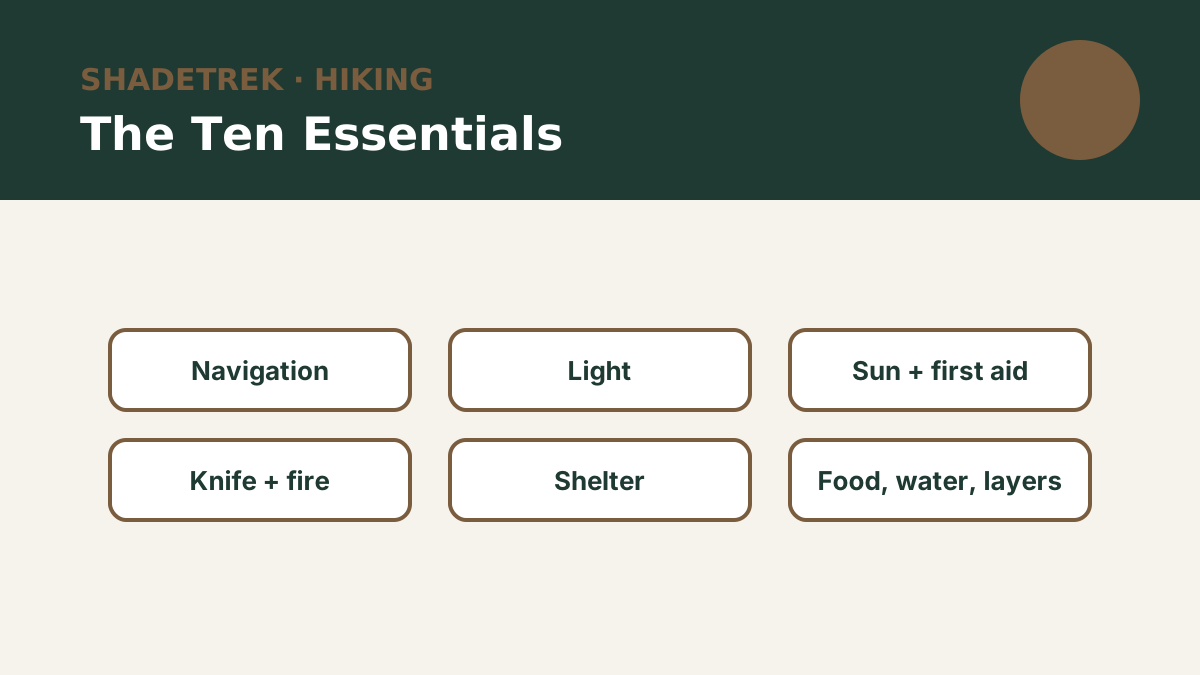
Most hikes go exactly as planned. The Ten Essentials are for the ones that don't: a wrong turn, a twisted ankle, a storm that rolls in early or a hike that runs past sunset. The system was developed by The Mountaineers, a Seattle-based outdoor group, and is used by the National Park Service (NPS) and REI. Today it's framed as ten systems rather than ten specific items, so you can scale each one to the trip. This guide explains each essential for a day hike and ends with a checklist.
The Ten Essentials
1. Navigation
A map of the area and a way to use it. That might be a paper map and compass, a GPS device or a phone app with downloaded offline maps. REI also lists a personal locator beacon or satellite communicator and a power bank under navigation. Phones are great tools, but batteries die and signal disappears in valleys, so download your map before you leave and carry a backup if you're going far.
2. Light
A headlamp with fresh or charged batteries, even if you plan to finish by lunch. Delays happen, and walking a trail in the dark with a phone flashlight is slow and drains your phone.
3. Sun protection
Sunglasses, sunscreen and sun-protective clothing such as a hat and long sleeves. UV is stronger at altitude and near snow and water. Pick sunglasses that block 100% of UV; our UV400 explainer covers what to look for, and our hiking sunglasses guide has picks. Our hiking page also lists a sun hoodie.
4. First aid
A small kit with adhesive bandages, gauze, tape, blister care, pain relievers and any personal medications. REI notes that the right kit depends on how far you travel into the backcountry and suggests blister treatment, personal medications such as an EpiPen if you need one, and a compression bandage for sprains. See our guide to preventing blisters.
5. Knife and repair kit
A small knife or multi-tool plus a few repair items, like duct tape wrapped around a water bottle, a few zip ties and cord.
6. Fire
A lighter or waterproof matches and a firestarter, for warmth or signaling in an emergency. Always follow local fire rules.
7. Emergency shelter
Something to protect you from wind and rain if you're stuck. For day hikes, a lightweight emergency bivy or space blanket is enough. It weighs a few ounces and takes up almost no space.
8. Extra food
More than you plan to eat. A spare energy bar or two, nuts or jerky cover a delay.
9. Extra water
Enough water for the hike, plus a way to treat more such as a filter or tablets if there are sources along the trail. Needs vary with heat, effort and your body, so carry more on hot days and steep climbs.
10. Extra clothes
Layers for the worst weather you might reasonably face: an insulating layer, a rain shell, a hat and gloves when it's cool, and spare socks. Mountain weather can change quickly. Our layering guide explains base, mid and shell layers.
The day hike checklist
| Category | Pack |
|---|---|
| Ten Essentials | Map/app + compass or GPS · headlamp · sunglasses, sunscreen, hat · first-aid kit with blister care · knife or multi-tool, tape · lighter or matches · emergency bivy or blanket · extra food · extra water or a filter · insulating layer, rain shell, spare socks |
| Wear | Broken-in boots or hiking shoes · wool or synthetic socks · moisture-wicking clothes |
| Carry | Day pack (about 18–30 L) · phone, charged · ID, cash or card · car key · trail permit or pass if needed |
| Nice to have | Trekking poles · insect repellent · whistle · trash bag · toilet paper and a trowel · camera |
Before you leave
- Check the forecast with the National Weather Service for the trailhead and summit if they differ much in elevation.
- Check trail conditions and closures with the park or land manager.
- Tell someone your plan: where you're going, your route and when you expect to be back.
- Know your turnaround time and stick to it.
Scaling the list to the trip
Because the Ten Essentials are systems, the right version depends on where you're going. On a short, busy trail close to town, "shelter" can be a 2-ounce space blanket, "navigation" a downloaded map on a charged phone, and "first aid" a few bandages and blister pads. On a longer hike into remote country, each system grows: a paper map and compass as backup, a satellite communicator, a fuller first-aid kit, water treatment and a warmer layer. REI makes the same point about first aid, noting that the farther you travel into the backcountry, the more you should bring.
Choosing a day pack
Most day hikers do well with an 18 to 30-liter pack. That's enough room for the Ten Essentials, water and a jacket. Look for a hip belt if you carry more than a few pounds, and a hydration sleeve if you like drinking from a tube. Our hiking page lists day packs including the Osprey Daylite Plus, Gregory Rhune 25L and Osprey Downburst 26L.
Where to start
ShadeTrek doesn't test gear hands-on. Our picks compare specs and owner reviews. Start with footwear in our top hiking boots and top hiking shoes, then fill out the rest of this list from our hiking page.
Key takeaways
- The Ten Essentials are navigation, light, sun protection, first aid, knife/repair kit, fire, shelter, extra food, extra water and extra clothes.
- The NPS and REI both use the list. Treat each as a system and scale it to the trip.
- Download offline maps and carry a headlamp, even on short hikes.
- Pack layers and a rain shell, since weather can change quickly.
- Check the forecast, tell someone your plan and set a turnaround time.
FAQ
What are the Ten Essentials for hiking?
Navigation, light (headlamp), sun protection, first aid, a knife and repair kit, fire, emergency shelter, extra food, extra water and extra clothes.
Do I need the Ten Essentials for a short day hike?
The NPS and REI recommend carrying them on every hike, scaled to the trip. On short hikes many items can be small and light, like a space blanket and mini first-aid kit.
What size backpack do I need for a day hike?
Most day hikers do well with an 18 to 30-liter pack, enough for the Ten Essentials, water and a jacket.
Is my phone enough for navigation?
A phone with downloaded offline maps is a good tool, but batteries and signal can fail. Carry a power bank and, on longer or remote hikes, a paper map and compass.
How much water should I bring on a day hike?
It depends on heat, effort, distance and your body. Carry more than you think you'll need, and bring a filter or tablets if there are water sources along the trail.
Sources
- National Park Service: The Ten Essentials
- REI Expert Advice: The Ten Essentials
- National Weather Service
This article is research-based. ShadeTrek did not test these products; information comes from the linked standards, expert guides, manufacturer specs and owner reviews. Some links are affiliate links. Not medical or safety advice for your specific situation.