
A warm sleeping bag can't fix a cold sleeping pad. The insulation under you gets crushed by your body weight, so the pad does most of the work of stopping the ground from pulling heat away. R-value is the number that tells you how well a pad does that, and most major brands now rate pads with the same standardized lab test, so you can compare them directly.
Who this guide is for
This guide is for hikers taking their first overnight or backpacking trips, campers who woke up cold from below and want to know what to change, and anyone stretching a summer setup into fall. If you're still building your day kit, start with our day hike packing checklist. Serious winter mountaineering and snow camping need more than this guide covers.
What matters most
1. R-value by temperature
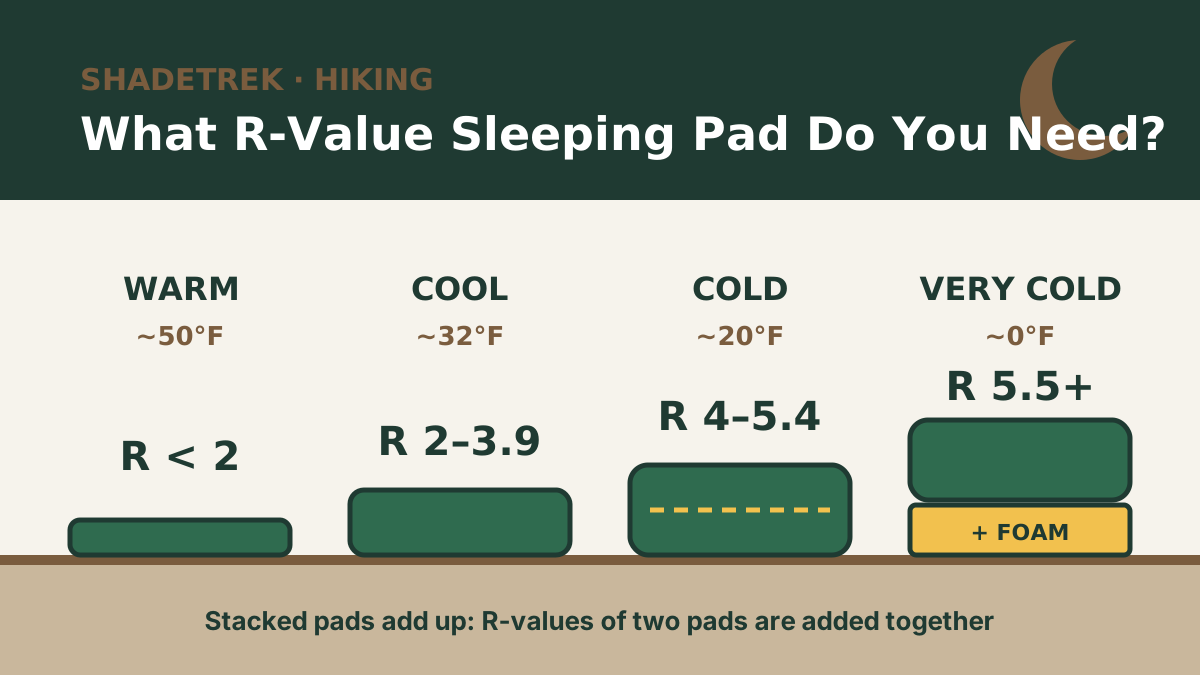
Higher R-value means more insulation from the ground. REI notes that a pad rated R 2.0 is twice as warm as one rated R 1.0. These are REI's general guidelines, and they're a starting point, not a guarantee:
| Conditions | Expected nighttime low | Pad R-value |
|---|---|---|
| Warm | About 50°F | Under 2 |
| Cool | About 32°F | 2–3.9 |
| Cold | About 20°F | 4–5.4 |
| Very cold | About 0°F | 5.5 and up |
Source: REI Expert Advice: How to Choose a Sleeping Pad.
REI also points out that sleeping bag temperature ratings assume a pad of about R 4. If you sleep warm, you may get by with R 2–3 for much of the year. If you sleep cold, go higher than the chart suggests. And plan around the ground, not just the air: cold, damp or frozen ground pulls heat faster.
2. The ASTM F3340 standard
ASTM F3340 is the shared test method for sleeping pad R-value. The pad is pressed between a warm plate and a cold plate, and the energy it takes to keep the warm plate at body temperature gives the R-value. NEMO, which helped develop the standard, explains that this lets you compare R-values within and across brands. Therm-a-Rest lists its pads under ASTM F3340-18, the first version.
Two caveats. ASTM itself says the result is a repeatable comparison that won't always match real-world warmth, because things like heat lost at the edges, compression and changing sleep positions aren't in the test. And R-value isn't a temperature rating: it's a property of the pad, while how warm you sleep also depends on your bag, clothing and metabolism. When you compare pads, look for "ASTM F3340" next to the number. Older or unbranded pads may use their own tests.
3. Stacking pads
R-value is additive: put two pads together and add their numbers. Both REI and NEMO describe it this way. That makes a closed-cell foam pad a cheap way to upgrade an air pad for winter. Therm-a-Rest says its Z Lite SOL adds R 2.0 when layered under another pad, so under an R 4.5 air pad you'd have about R 6.5. The foam layer also protects the air pad from sharp rocks and frozen ground.
4. Air vs self-inflating vs foam
- Insulated air pads are the lightest and most packable way to get a high R-value. Insulation comes from internal baffles, reflective films or synthetic fill. Air pads without insulation are best kept for warm nights. Air pads can puncture, so carry the repair kit.
- Self-inflating pads have an open-cell foam core that expands and draws air in when you open the valve. Therm-a-Rest says this usually takes 5–15 minutes and recommends topping them off with a breath or pump sack. They're heavier and bulkier than air pads for the same warmth, but they're less likely to go fully flat.
- Closed-cell foam pads are cheap, can't pop and work as camp seats, but they're thin and bulky on the outside of a pack. On their own they suit warm to cool nights, and under an air pad they add warmth.
Therm-a-Rest's winter tip for self-inflating pads: in freezing weather, use a pump sack instead of your breath, since moisture from your breath can freeze inside the pad.
5. Weight, thickness and size
Thicker pads are usually more comfortable, especially for side sleepers, but thickness doesn't equal warmth. Two pads of the same thickness can have very different R-values depending on what's inside, so check the R-value. On weight, the Regular sizes of the two pads below come in at 13 oz (air) and 14 oz (foam), which is a useful reference for light backpacking gear. Width and length matter too: a 20-inch pad is standard, and wider sizes help if you sprawl or your elbows fall off the edge.
Mistakes to avoid
- Spending on the bag and skimping on the pad. Bag ratings assume a pad of around R 4. A thin summer pad can make a warm bag feel cold.
- Comparing R-values from different tests. Look for ASTM F3340 ratings so you're comparing like with like.
- Buying for the average night. Choose for the coldest low you expect, then stack foam if a trip runs colder.
- Treating thickness as warmth. A thick uninsulated air pad can still be cold.
- Skipping a practice inflation. Inflate a new pad at home, check it holds air overnight and learn the valve before the trip.
- Leaving the repair kit at home. A flat air pad on cold ground is a long night.
Two pads that cover most of the chart
Therm-a-Rest NeoAir XLite NXT (R 4.5, insulated air pad)
An ultralight insulated air pad for three-season trips and nights that dip below freezing. Therm-a-Rest lists the Regular size at R 4.5, 13 oz (0.37 kg), 3 in (7.6 cm) thick and 20 x 72 in, packing to about 9 x 4.1 in, with a WingLock valve, pump sack, stuff sack and field repair kit included. R 4.5 lands in REI's cold-weather range, and adding a foam pad underneath stretches it toward winter use. The link goes to the Regular size in Solar Flare (Therm-a-Rest SKU 14010). Check price on Amazon #ad
Therm-a-Rest Z Lite SOL (R 2.0, closed-cell foam)
A folding foam pad for warm to cool nights on its own, or as a stacking layer under an air pad when it's cold. Therm-a-Rest lists the Regular size at R 2.0, 14 oz (0.41 kg), 0.75 in (2 cm) thick and 20 x 72 in, folding to 20 x 5 x 5.5 in, with a reflective ThermaCapture surface that should face up. It can't puncture and doubles as a camp seat. The link goes to the Regular size in Blue/Silver. Check price on Amazon #ad
Together, the Z Lite SOL under the XLite NXT adds up to about R 6.5, past the very-cold line on the chart. A pad is only one part of staying warm: pair it with the layers in our fall hiking layering guide, pack a light for camp (our headlamp lumens guide helps you choose one), and browse current packs and boots on our hiking gear deals page.
Key takeaways
- Pick the pad for your coldest expected night: under R 2 near 50°F, R 2–3.9 near 32°F, R 4–5.4 near 20°F, R 5.5+ near 0°F.
- About R 4 is a sensible three-season all-rounder, and bag ratings assume roughly that.
- Compare ASTM F3340 ratings. They're lab comparisons, not temperature promises.
- R-values stack: foam under an air pad adds its full R-value.
- Thickness is comfort, not warmth. Check the R-value.
FAQ
What R-value sleeping pad do I need for 3-season camping?
For most spring, summer and fall trips, a pad around R 2 to 4 works. REI's chart pairs R 2 to 3.9 with nights near freezing (about 32°F) and R 4 to 5.4 with nights around 20°F, so if your fall trips dip below freezing, aim for R 4 or more.
What R-value do I need for camping below freezing?
REI's guidelines put R 4 to 5.4 at cold nights around 20°F and R 5.5 or more at very cold nights around 0°F. Many winter campers reach those numbers by putting a closed-cell foam pad under an insulated air pad.
Can you stack sleeping pads to add R-value?
Yes. R-value is additive, so the R-values of two stacked pads are simply added together. NEMO and REI both describe it this way. For example, a Therm-a-Rest Z Lite SOL (R 2.0) under a NeoAir XLite NXT (R 4.5) gives about R 6.5.
Is a higher R-value too warm in summer?
Not usually. A pad insulates you from the ground rather than producing heat, so a warmer pad mostly just stops ground chill. NEMO does note that in very warm weather a lower R-value lets you shed more heat, so a light pad is a fine summer choice.
What is ASTM F3340?
It is the industry standard test for sleeping pad R-value. A pad is held between a warm plate and a cold plate, and the energy needed to keep the warm plate at body temperature gives the R-value. Because brands use the same test, you can compare R-values across brands. It is a lab comparison, not a temperature rating.
Sources
- REI Expert Advice: How to Choose a Sleeping Pad
- NEMO: New Standardized R-Value and ASTM F3340
- ASTM F3340: Standard Test Method for Thermal Resistance of Camping Mattresses
- Therm-a-Rest NeoAir XLite NXT specifications
- Therm-a-Rest Z Lite SOL specifications
This article is research-based. ShadeTrek did not test these products; information comes from the linked expert guides, the ASTM standard summary and manufacturer specs. Some links are affiliate links. Not safety advice for your specific situation.